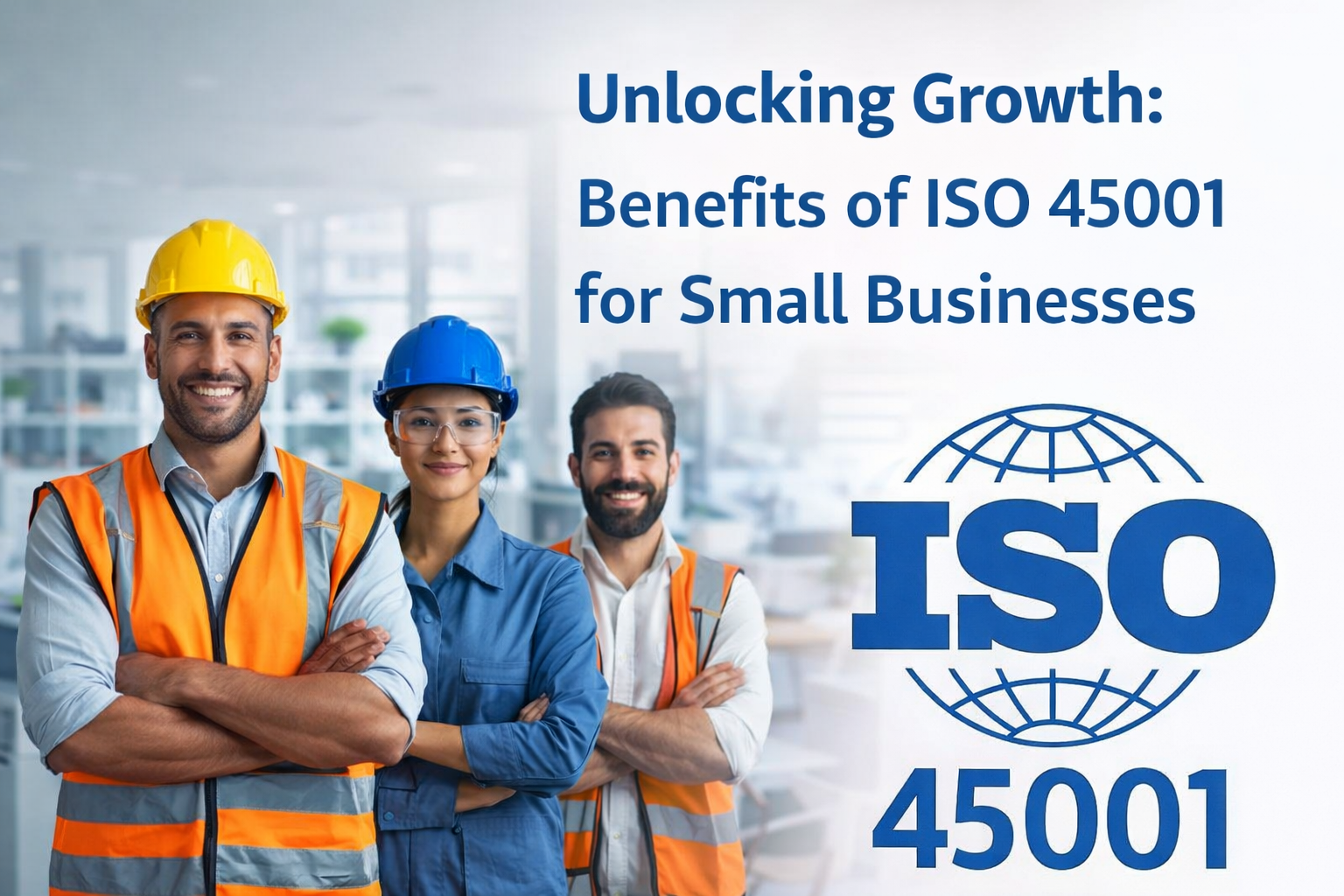
Unlocking Growth: Benefits of ISO 45001 for Small Businesses
In today’s competitive market, small businesses can’t afford to compromise on workplace safety or legal compliance. That’s where ISO 45001 comes in — a globally recognized Occupational Health and Safety (OH&S) Management System designed to help organizations, big or small, establish a safer, more productive environment while strengthening their business performance.
Contrary to the assumption that ISO standards are only relevant to multinational corporations, ISO 45001 delivers powerful advantages for small enterprises too. From protecting employees to boosting reputation and lowering costs, this standard provides a structured and proactive framework that transforms how safety is managed.
In this article, we explore why ISO 45001 is essential for small businesses, the key benefits it brings, and how it helps build long-term success.
What is ISO 45001?
ISO 45001 is an international standard that defines requirements for an Occupational Health and Safety (OH&S) Management System. It gives organizations a structured approach to identify risks, eliminate hazards, and improve safety performance, ultimately leading to a healthier and more secure workplace.
This standard applies to businesses of all sizes and industries, including small companies that may lack formal health and safety systems but are eager to grow responsibly and sustainably.
Key Benefits of ISO 45001 for Small Businesses
Implementing ISO 45001 offers multiple strategic advantages. Below is a detailed breakdown of the most impactful benefits:
1. Enhanced Workplace Safety
At its core, ISO 45001 helps small businesses create a safer working environment. By systematically identifying hazards and implementing measures to control them, you can reduce the likelihood of injuries, illnesses, and workplace accidents.
This not only protects your workforce but also avoids the operational disruptions that accidents often cause — a crucial benefit for small teams where even one incident can significantly impact productivity.
2. Proactive Risk Identification
ISO 45001 shifts safety management from reactive to proactive. Instead of responding to incidents after they occur, the OH&S framework encourages small businesses to anticipate risks in advance and take preventative action.
This proactive mindset helps reduce hazards before they become major problems and fosters a culture of continuous improvement and risk awareness.
3. Legal and Regulatory Compliance
Small businesses often struggle to keep up with local and national safety regulations. ISO 45001 provides a compliance roadmap, helping you align workplace practices with legal requirements and industry standards.
This structured approach minimizes the risk of costly fines and legal penalties, freeing you to focus on growth rather than regulatory uncertainty.
4. Improved Employee Engagement and Morale
Employees thrive in environments where their well-being is valued. Implementing ISO 45001 demonstrates that health and safety are top priorities, which can significantly boost morale and motivation.
Involving workers in safety discussions and decisions increases engagement and creates shared responsibility — leading to higher productivity and decreased absenteeism.
5. Stronger Reputation and Competitive Advantage
Small businesses often rely on reputation to win clients and customers. Being certified under ISO 45001 signals professionalism, responsibility, and commitment to best practices. This makes your business more attractive to clients, investors, and suppliers who prioritize safety-conscious partners.
In markets where corporate clients require safety certifications from suppliers, ISO 45001 can become a major differentiator.
6. Operational Efficiency and Cost Savings
While implementing ISO 45001 requires time and investment, it can lead to considerable long-term savings. Fewer accidents mean less downtime, reduced compensation claims, and lower insurance premiums — all of which help strengthen your bottom line.
Additionally, a safer workplace results in less disruption and more consistent performance, which supports smoother operations and better use of resources.
7. Reduced Absenteeism and Workforce Turnover
When employees feel safe and respected, they are more likely to stay with your business long-term. ISO 45001 contributes to a supportive culture that lowers absenteeism and reduces turnover.
For small companies where workforce continuity is critical, these improvements can be especially impactful.
8. Better Prepared for Emergencies
ISO 45001 encourages you to develop plans and protocols for emergencies and unexpected events. This preparedness strengthens your ability to respond quickly and effectively when situations arise, minimizing loss and disruption.
9. Integration with Other Management Systems
ISO 45001’s structure is compatible with other ISO standards such as ISO 9001 (Quality Management) and ISO 14001 (Environmental Management). This allows small businesses to integrate multiple systems, streamlining operations and reducing administrative complexity.
10. Boosts Overall Organizational Resilience
By embedding proactive safety management into day-to-day operations, ISO 45001 helps your business adapt to changes, identify opportunities for improvement, and handle risks more effectively — strengthening resilience across all levels.
ISO 45001 Benefits Summary Table
|
Benefit Category
|
Impact on Small Businesses
|
|
Workplace Safety
|
Reduces accidents and injuries
|
|
Risk Management
|
Proactive identification of hazards
|
|
Legal Compliance
|
Meets OH&S regulations and reduces penalties
|
|
Workforce Morale
|
Increases employee engagement and retention
|
|
Reputation
|
Enhances credibility with clients/stakeholders
|
|
Financial
|
Lowers costs via reduced downtime and insurance
|
|
Productivity
|
Boosts efficiency and performance consistency
|
|
Preparedness
|
Improved emergency response
|
|
System Integration
|
Works with other ISO systems
|
How ISO 45001 Implementation Actually Works
Implementing ISO 45001 usually involves these phased steps:
- Gap Analysis – Assess your current safety practices and identify areas that need improvement.
- Planning – Develop safety objectives, policies, and processes.
- Training & Implementation – Educate employees and roll out new safety measures.
- Documentation – Keep structured records of procedures and performance.
- Internal Audits & Review – Regularly check compliance and effectiveness.
- Certification Audit – Once ready, undergo an external audit for ISO 45001 certification.
Unlike other standards, ISO 45001 is scalable and flexible enough to suit small businesses even with limited resources — making it a practical investment rather than a burden.
Who Should Consider ISO 45001 Certification?
ISO 45001 is suitable for all types of small businesses, regardless of industry or workforce size. Any organization that wants to improve workplace safety and manage health and safety risks in a structured way can benefit from this standard.
Small businesses that should especially consider ISO 45001 include:
- Manufacturing units with machinery and physical hazards
- Construction and contracting businesses
- Warehouses and logistics companies
- Service businesses with field staff
- Workshops and small factories
Even if risks seem minimal, ISO 45001 helps small businesses establish clear procedures and responsibilities, ensuring that safety is managed consistently and effectively.
Common Challenges Small Businesses Face Without ISO 45001
Many small businesses manage safety informally, which can lead to hidden risks and long-term problems. Without a proper OH&S Management System, businesses may face:
- Lack of documented safety procedures
- Poor awareness of workplace hazards
- Higher chances of accidents and injuries
- Difficulty proving legal compliance
- Low employee confidence in safety practices
ISO 45001 solves these issues by introducing a structured approach to risk identification, safety planning, employee involvement, and continuous improvement.
How ISO 45001 Supports Long-Term Business Stability
ISO 45001 is not only about preventing accidents; it also supports business continuity and stability. When safety risks are controlled, businesses experience:
- Fewer disruptions in daily operations
- Better workforce availability
- More predictable project timelines
- Improved client trust and retention
For small businesses, this stability is essential for consistent growth and strong customer relationships.
Real Impact: Small Business Success Stories
Across industries — from small manufacturing units and local workshops to service providers — companies that adopt ISO 45001 often report:
- Notable reduction in workplace injuries
- Better employee retention
- Faster response to legal inspections
- Increased customer confidence
- Growth in new business opportunities
These gains don’t just improve safety but also contribute to revenue growth, team trust, and operational excellence.
Conclusion: ISO 45001 as a Long-Term Growth Partner for Small Businesses
ISO 45001 is not just about meeting safety requirements — it is about building a strong foundation for long-term business success. For small businesses, it provides a practical and structured way to reduce workplace risks, stay compliant with regulations, and protect the most valuable asset: employees.
By implementing ISO 45001, small businesses can improve workplace safety, boost employee confidence, increase operational efficiency, and strengthen their market reputation. It also helps reduce accidents, downtime, and unexpected costs, making daily operations smoother and more reliable.
In a competitive business environment where safety and trust matter more than ever, ISO 45001 gives small businesses the confidence to grow responsibly and sustainably. Choosing ISO 45001 means choosing safer workplaces, stronger teams, and a more secure future for your business.
Frequently Asked Questions (FAQs)
1] What is ISO 45001 in simple terms?
ISO 45001 is an international standard for Occupational Health and Safety (OH&S) Management Systems that helps organizations identify hazards, reduce workplace risks, and improve employee safety through a structured approach, as defined by the International Organization for Standardization (ISO).
(Source: ISO – https://www.iso.org/iso-45001-occupational-health-and-safety.html)
2] Is ISO 45001 useful for small businesses?
Yes, ISO 45001 is suitable for organizations of all sizes, including small businesses. ISO clearly states that the standard is applicable to any organization, regardless of size, type, or industry, making it flexible and scalable for small enterprises.
(Source: ISO – https://www.iso.org/standard/63787.html)
3] Does ISO 45001 help with legal compliance?
Yes, ISO 45001 requires organizations to identify and comply with applicable occupational health and safety legal requirements, helping businesses systematically manage compliance and reduce the risk of penalties or legal action.
(Source: ISO Publication – https://www.iso.org/files/live/sites/isoorg/files/store/en/PUB100427.pdf)
4] How long does it take to get ISO 45001 certification?
The certification timeline depends on the size of the organization and existing safety practices. For many small businesses, implementation and certification can typically be completed within a few weeks to a few months when proper systems and training are in place.
(Source: NQA Certification Body – https://www.nqa.com/en-in/certification/standards/iso-45001)
5] Will ISO 45001 increase business costs?
While there are initial implementation and certification costs, ISO standards are proven to reduce long-term expenses by minimizing workplace accidents, improving productivity, and lowering insurance and compensation claims.
(Source: ISO – https://www.iso.org/benefits-of-standards.html)
6] Can ISO 45001 be combined with other ISO standards?
Yes, ISO 45001 follows ISO’s High-Level Structure (HLS), which allows easy integration with other standards such as ISO 9001 and ISO 14001 into a single Integrated Management System.
(Source: ISO – https://www.iso.org/management-system-standards.html)