In today’s competitive business environment, quality, safety, and security are more important than ever. This is where ISO certifications play a vital role. If you are searching for a complete ISO certification list, this guide will help you understand the most important ISO standards, their purpose, and how they benefit your business.
ISO (International Organization for Standardization) develops global standards that ensure products and services are safe, reliable, and of high quality. From quality management to information security, ISO certifications cover almost every industry.
What is ISO Certification?
ISO certification is a formal recognition that a company follows internationally accepted standards in its operations. It ensures consistency, efficiency, and customer satisfaction.
Businesses of all sizes—from startups to multinational corporations—can obtain ISO certification to improve credibility and gain a competitive edge.
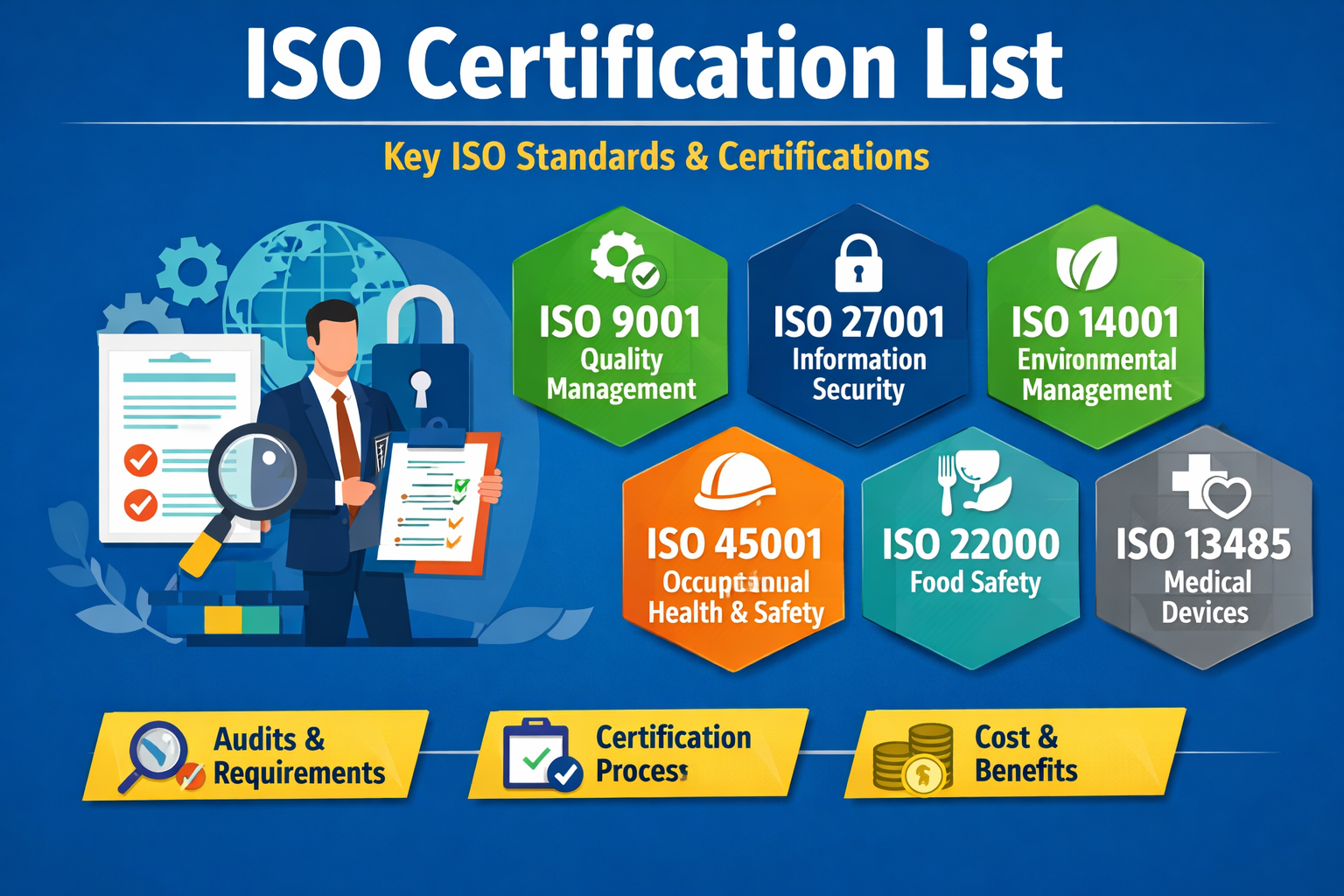
Complete ISO Certification List (Most Popular Standards)
Here is a categorized ISO certification list based on industry relevance:
1. Quality Management Standards
-
ISO 9001 (Quality Management System)
The most popular standard worldwide, focusing on customer satisfaction and continuous improvement. -
ISO 9000
Fundamentals and vocabulary for quality management systems. -
ISO 9001:2015
Latest version of ISO 9001 with updated requirements.
2. Information Security Standards
-
ISO 27001
Information Security Management System (ISMS) standard. -
ISO 27001:2022
Latest version with improved security controls. -
ISO 27000
Overview of information security standards. -
ISO 27701
Privacy Information Management System. -
ISO 27017
Cloud security guidelines.
3. Environmental Management Standards
-
ISO 14001
Environmental Management System (EMS). -
ISO 14001:2015
Updated environmental standard. -
ISO 14064
Greenhouse gas emissions management.
4. Occupational Health & Safety Standards
-
ISO 45001
Occupational Health and Safety Management System. -
ISO 45001:2018
Latest version ensuring workplace safety. -
ISO 45003
Psychological health and safety at work.
5. Food Safety Standards
-
ISO 22000
Food Safety Management System. -
FSSC 22000
Advanced food safety certification scheme.
6. Industry-Specific ISO Standards
-
ISO 13485 – Medical devices quality management
-
ISO 14971 – Risk management for medical devices
-
ISO 26262 – Automotive functional safety
-
IATF 16949 – Automotive quality management
-
ISO 21434 – Automotive cybersecurity
7. Laboratory & Testing Standards
-
ISO 17025
Testing and calibration laboratories. -
ISO 15189
Medical laboratories.
8. Business Continuity & Risk Management
-
ISO 22301
Business continuity management. -
ISO 31000 / ISO 31030
Risk management and travel risk.
9. IT & Service Management
-
ISO 20000
IT service management.
10. Anti-Bribery & Compliance Standards
-
ISO 37001
Anti-bribery management system. -
ISO 37301
Compliance management.
Benefits of ISO Certification
Getting certified from the ISO certification list provides multiple advantages:
1. Improved Business Credibility
ISO certification builds trust among customers and stakeholders.
2. Better Process Efficiency
Standardized procedures reduce errors and increase productivity.
3. Global Recognition
ISO-certified companies gain international market access.
4. Customer Satisfaction
Focus on quality improves customer experience.
5. Legal Compliance
Helps businesses meet regulatory requirements.
ISO 9001: Quality Management System Explained
ISO 9001 is the backbone of quality management systems (QMS). It focuses on:
-
Customer satisfaction
-
Continuous improvement
-
Process-based approach
-
Risk-based thinking
ISO 9001 Requirements:
-
Quality policy and objectives
-
Documented processes
-
Internal audits
-
Management review
-
Corrective actions
ISO 27001: Information Security Management
ISO 27001 helps organizations protect sensitive information.
Key Features:
-
Data security controls
-
Risk assessment
-
Cybersecurity framework
-
Compliance with data laws
ISO 27001 Audit Includes:
-
Risk analysis
-
Security controls review
-
Documentation check
-
Compliance verification
ISO 14001: Environmental Management
ISO 14001 helps organizations reduce environmental impact.
Key Benefits:
-
Reduced waste
-
Lower energy consumption
-
Improved sustainability
-
Compliance with environmental laws
ISO Certification Process (Step-by-Step)
Here is the standard process to obtain ISO certification:
Step 1: Choose the Right ISO Standard
Select from the ISO certification list based on your business needs.
Step 2: Gap Analysis
Identify gaps between current practices and ISO requirements.
Step 3: Documentation
Prepare policies, procedures, and manuals.
Step 4: Implementation
Apply the system across your organization.
Step 5: Internal Audit
Check readiness before certification audit.
Step 6: Certification Audit
Conducted by an accredited certification body.
Step 7: Certification Issued
Upon successful audit, certification is granted.
ISO Certification Cost in India
The cost of ISO certification depends on:
-
Organization size
-
Number of employees
-
Type of ISO standard
-
Certification body
Approximate Cost:
-
Small businesses: ₹15,000 – ₹50,000
-
Medium businesses: ₹50,000 – ₹1,50,000
-
Large organizations: ₹1,50,000+
ISO Audit Explained
ISO audits ensure compliance with standards.
Types of ISO Audits:
-
Internal Audit
-
External Audit
-
Surveillance Audit
Audits help maintain certification and improve processes.
ISO Accreditation vs Certification
-
Certification: Issued to companies
-
Accreditation: Given to certification bodies
Both ensure credibility and trust.
Common Mistakes to Avoid
-
Choosing the wrong ISO standard
-
Poor documentation
-
Lack of employee training
-
Ignoring internal audits
-
Hiring inexperienced consultants
How to Choose the Right ISO Certification
Select based on your industry:
-
Manufacturing → ISO 9001, ISO 14001
-
IT Companies → ISO 27001, ISO 20000
-
Healthcare → ISO 13485, ISO 15189
-
Food Industry → ISO 22000
Future of ISO Standards
With growing digital transformation, ISO standards are evolving:
-
Increased focus on cybersecurity
-
Sustainability and ESG standards
-
AI and data protection guidelines
Conclusion
The ISO certification list includes a wide range of standards that help businesses improve quality, safety, efficiency, and compliance. Whether you need ISO 9001 for quality, ISO 27001 for data security, or ISO 14001 for environmental management, choosing the right certification can transform your business.
Investing in ISO certification is not just about compliance—it’s about building trust, improving processes, and achieving long-term success.
FAQs
1. What is the most popular ISO certification?
ISO 9001 is the most widely used quality management standard.
2. How long does ISO certification take?
Typically 1 to 6 months depending on organization size.
3. Is ISO certification mandatory?
No, but it is highly recommended for business growth.
4. What is ISO 27001 used for?
It is used for information security management.
5. What is ISO 14001 certification?
It focuses on environmental management systems.
6. How much does ISO certification cost?
It ranges from ₹15,000 to ₹1,50,000+ depending on business size.
7. What is ISO audit?
An evaluation of compliance with ISO standards.
8. Can small businesses get ISO certified?
Yes, ISO certification is suitable for all business sizes.
9. What is ISO accreditation?
Approval given to certification bodies.
10. Which ISO certification is best?
It depends on your industry and business needs.